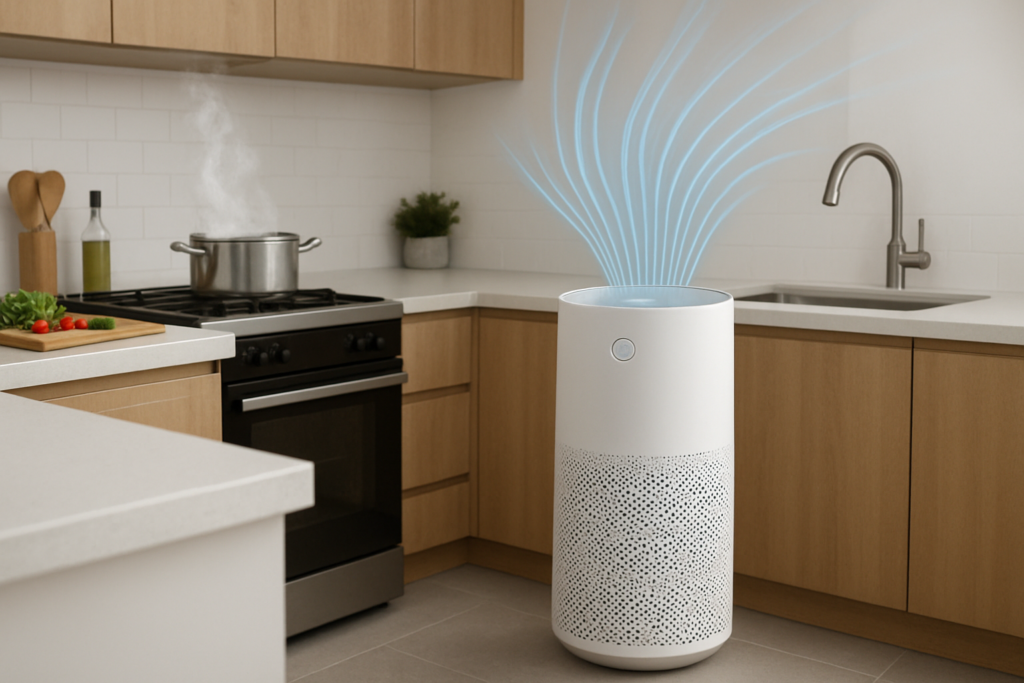
We have all been there. You sear a perfect steak or fry up a batch of bacon, and while the meal is delicious, the scent lingers long after the dishes are done. By the next morning, that savory aroma has turned into a stale, heavy “kitchen ghost” that seems to haunt your curtains and upholstery.
Traditional range hoods often fall short, merely moving air around rather than cleaning it. However, a new generation of smart air purifiers is changing the game. These devices do not just mask smells; they utilize advanced chemical filtration and real-time sensors to scrub the air clean in minutes.
Affiliate Disclosure
This post contains affiliate links. If you purchase through these links, I may earn a small commission at no extra cost to you. I only recommend products and services that meet high standards for indoor air quality, such as FiltersFast and FieldControls.
The Science of Scent: Why Cooking Odors Stick
Cooking odors are comprised of Volatile Organic Compounds (VOCs) and airborne grease particles. While a standard filter might catch dust, it takes a specific type of technology to trap a smell. This is why Understanding Air Purifier Technology: HEPA, Activated Carbon, and Beyond is essential for any homeowner.
To truly neutralize a kitchen, you need a heavy-duty activated carbon filter. This material acts like a chemical sponge, soaking up VOCs before they can settle into your furniture. Poor Indoor Air Quality (IAQ) isn’t just an olfactory nuisance; it can affect your long-term comfort and respiratory health.
The FieldControls Advantage: Professional Grade Filtration
When it comes to high-velocity odor removal, FieldControls stands out by bringing industrial-strength technology into the residential space. Their systems are designed to handle the heavy lifting that smaller, “boutique” purifiers simply cannot manage.
By integrating their systems into your home, you gain access to high-flow filtration that targets both particulates and gases simultaneously. This is particularly effective for open-concept homes where kitchen smells quickly migrate to the living room.

Upgrade your home with FieldControls hardware: Shop FieldControls Air Solutions
Automation: The “Set and Forget” Kitchen Solution
The “Smart” in smart purifiers refers to more than just a mobile app. It refers to Laser Particle Sensors and VOC detectors that monitor your air quality 24/7. When you start sautéing onions, the purifier detects the spike in organic compounds and automatically ramps up the fan speed to “Turbo” mode.
This proactive approach ensures that odors are captured at the source before they have a chance to dissipate throughout the house. For a deeper dive into how these sensors work, see my Smart Air Purifiers Guide: Automation, Sensors & Home Integration.
The Hidden Cost: Maintaining Your Defense
A purifier is only as good as its last filter change. Cooking grease is particularly “sticky” and can clog a filter faster than standard household dust. If you want your device to remain effective, you must stay on top of replacements.
One of the most reliable sources for finding the exact match for your machine—at a better price point than big-box retailers—is FiltersFast. They simplify the process of maintaining your IAQ by offering a massive catalog of compatible filters for almost every major brand.
Find your replacement filters here: Browse FiltersFast Catalog
Before you commit to a specific model, it is wise to calculate the long-term overhead. I’ve broken down the math in my analysis of How Much You Really Spend on Filters Over 5 Years.
Standard vs. Smart Odor Purifiers
| Feature | Standard Air Purifier | Smart Odor Purifier |
|---|---|---|
| Sensor Type | None or Basic Dust | VOC + Laser Particle |
| Filtration | Thin Carbon Sheet | Deep-Bed Activated Carbon |
| Response | Manual Adjustment | Automatic Auto-Mode |
| Odor Removal | 1 – 2 Hours | 10 – 20 Minutes |
| Connectivity | None | WiFi / Voice Control |
Frequently Asked Questions about Cooking Odors
How long does it take for a smart purifier to remove cooking smells?
Most high-end smart purifiers with a high Clean Air Delivery Rate (CADR) can cycle the air in a standard kitchen every 10 to 12 minutes. In “Auto” mode, they typically neutralize strong odors within 20 minutes of cooking being complete.
Do HEPA filters remove cooking smells?
Technically, no. HEPA filters are designed to trap particles such as smoke and grease droplets. To remove the actual smell (gas/VOCs), you need an Activated Carbon filter. The best units combine both.
Where is the best place to put a purifier for kitchen odors?
Place the unit between the kitchen and the rest of the house, or near a return air vent. Avoid placing it directly next to the stove, as heavy grease can prematurely coat the sensors and filters.