Maintaining healthy indoor air quality starts with accurate data. If you have ever looked at an air purifier and wondered how it “knows” when to ramp up its fan speed, the answer lies in its internal sensors. Most modern devices use one of two technologies: Laser Scattering or Infrared LED.
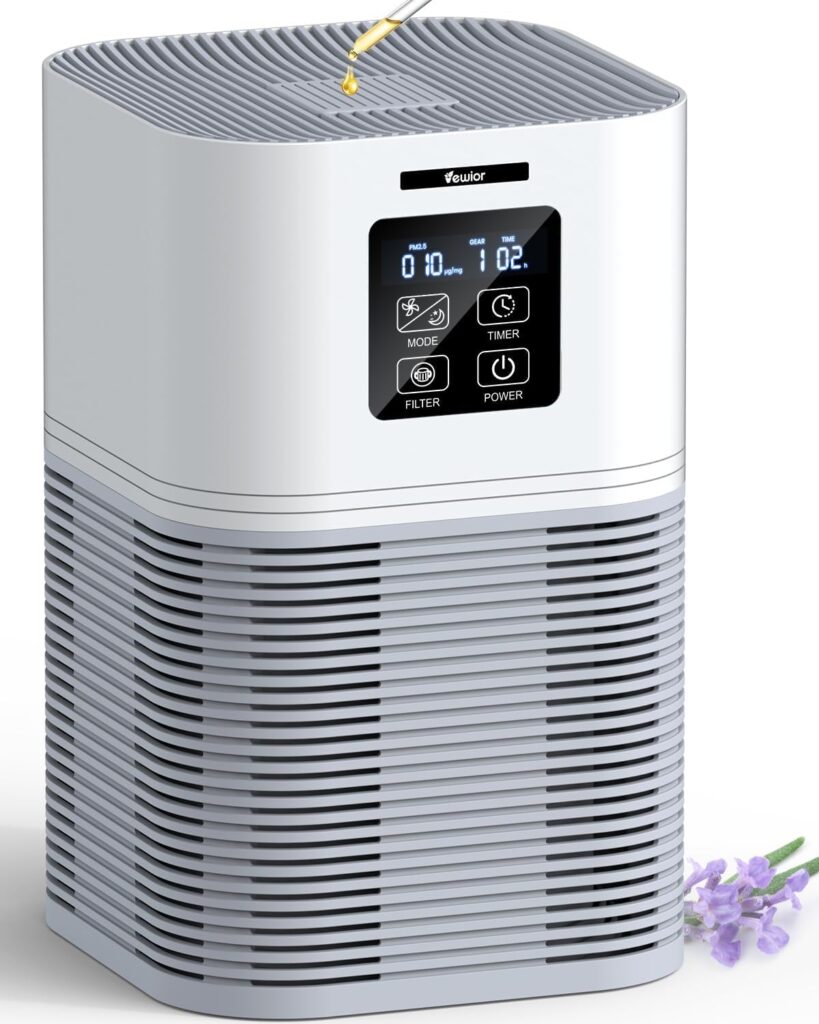
While both aim to detect particulate matter (PM2.5), they operate on vastly different scientific principles. This guide breaks down the performance gap to help you choose the most reliable technology for your home.
Disclosure: This post contains affiliate links. If you make a purchase through these links, we may earn a small commission at no extra cost to you. We only recommend products from trusted partners like FiltersFast and FieldControls.
The Core Difference: How These Sensors See Dust
To understand accuracy, we must first look at the mechanics of “seeing” invisible particles.
What is an Infrared Air Quality Sensor?
Infrared sensors are the traditional “budget-friendly” option. They use an infrared light-emitting diode (LED) as a light source. As air passes through the sensor, particles scatter the light. A photosensitive element detects the intensity of this reflection to estimate particle concentration.
However, infrared sensors typically rely on a heating resistor to create a “chimney effect” for airflow. This method is passive and slow, often failing to capture rapid changes in air quality.
What is a Laser Air Quality Sensor?
Laser sensors represent the “gold standard” in consumer technology. Instead of a simple LED, they use a focused laser beam and a dedicated fan to pull air through the chamber at a constant rate. This active sampling allows the sensor to count individual particles and measure their size with high precision.
Accuracy Comparison: Laser vs. Infrared
When comparing these two, the “winner” for accuracy is objectively the laser sensor. Here is why:
- Particle Size Detection: Infrared sensors generally struggle to detect anything smaller than 1.0 microns. Since the most dangerous pollutants (PM2.5) are often smaller than this, infrared sensors may provide a “clean” reading even when fine dust is present. Laser sensors can detect particles as small as 0.3 microns.
- Consistency: Because laser sensors use fans to control airflow, they provide a stable stream of data. Infrared sensors are highly sensitive to ambient light and temperature fluctuations, which can lead to “false positives” or erratic readings.
- Data Processing: Laser sensors are paired with higher-performance microcontrollers (MCUs) that use complex algorithms to distinguish between dust, smoke, and pollen.
Comparison Table: At a Glance
| Feature | Infrared (LED) Sensors | Laser Scattering Sensors |
|---|---|---|
| Detection Principle | Light Reflection (Passive) | Light Scattering (Active) |
| Airflow Method | Thermal Resistor (Slow) | Internal Fan (Fast/Constant) |
| Min. Particle Size | ~1.0 Microns | ~0.3 Microns |
| Accuracy Margin | ±30% | ±10% |
| Common Use | Budget Air Purifiers | Pro Monitors / High-End Purifiers |
| Lifespan | Long (Simple parts) | Moderate (Fan may wear out) |
Which One Should You Choose?
If you are looking for an entry-level device to get a general idea of “dusty” vs. “not dusty,” an infrared sensor is a cost-effective choice. Many people find these sufficient for basic automation in small rooms.
However, for those with allergies or asthma, or who live in areas prone to wildfire smoke, a laser sensor is essential. It provides the precision needed to capture the microscopic particles that actually impact respiratory health.
For high-quality replacement filters or sensor-equipped systems, check out the specialized inventory at FiltersFast or explore professional-grade solutions from FieldControls.

Further Reading
- Understanding Air Purifier Technology: HEPA, Activated Carbon, and Beyond
- Smart Air Purifiers Guide: Automation, Sensors & Home Integration
- External Resource: Indoor Air Quality (IAQ) Standards
Frequently Asked Questions
Is a laser air quality sensor better than an infrared one?
Yes, laser sensors are significantly more accurate. They use a focused light beam and a fan to detect smaller particles (down to 0.3 microns) compared to the 1.0-micron limit of most infrared sensors.
Can infrared sensors detect PM2.5?
While infrared sensors can detect PM2.5, they are much less precise than laser versions. They often miss smaller particles within the PM2.5 range and are prone to interference from humidity and light.
Why are laser sensors more expensive?
Laser sensors require more complex hardware, including a laser diode, a constant-speed fan, and a more powerful internal processor to calculate particle counts accurately.
Do air quality sensors need calibration?
Most consumer-grade laser sensors are factory-calibrated but can drift over time. Higher-end monitors may allow for manual calibration, whereas budget infrared sensors usually do not support this feature.