If you are upgrading your home’s air quality this year, you have likely noticed a new buzzword stamped across the boxes of high-end models: Matter.
For years, the gold standard for connected home appliances was simple Wi-Fi connectivity. Now, the smart home industry is pushing the Matter protocol as the ultimate solution for consumers. But if both types of purifiers connect to your wireless router, what exactly are you paying for?
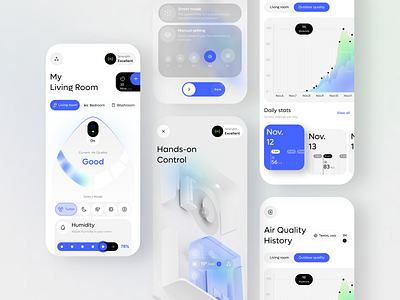
Understanding the distinction between standard Wi-Fi and Matter is critical for your wallet, your privacy, and your daily convenience. Let us break down the exact differences so you can make an informed, future-proof purchase.
Disclosure: This post contains affiliate links. If you purchase through these links, we may earn a small commission at no extra cost to you. This helps us continue testing and reviewing the best air quality technology on the market.
The Baseline: Standard Wi-Fi Air Purifiers
To understand why Matter exists, we first need to look at how standard Wi-Fi air purifiers operate.
When you buy a traditional smart purifier, it connects to your home’s Wi-Fi network and communicates directly with the manufacturer’s cloud servers. To control the device, you must download the brand’s specific proprietary app.
While this technology is proven and widely available, it comes with a few distinct drawbacks. First, if your internet goes down, your smart controls go down with it. Second, integrating these devices into a broader smart home ecosystem (like making your purifier talk to your smart thermostat) often requires clunky cloud-to-cloud workarounds that introduce lag.
If you are looking for a deep dive into how these traditional integrations work, check out our comprehensive Smart Air Purifiers Guide: Automation, Sensors & Home Integration.
The Upgrade: What is a Matter Air Purifier?
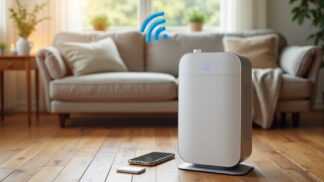
Here is the most important fact to understand: Matter is not a replacement for Wi-Fi. Matter is a universal language that runs over your existing Wi-Fi (or Thread) network.
Developed by an alliance of tech giants including Apple, Google, Amazon, and Samsung, the Matter standard was designed to eliminate “app clutter” and vendor lock-in. When you purchase a Matter-certified air purifier, you do not necessarily need to download the manufacturer’s app. Instead, you can scan a QR code and add it directly to Apple Home, Google Home, Amazon Alexa, or Samsung SmartThings.
Furthermore, Matter operates on a local-first basis. This means your smartphone or smart speaker sends commands directly to the purifier over your local network, bypassing the cloud entirely. The result is lightning-fast response times and devices that continue to function perfectly even if your internet service drops.
If you want to ensure your indoor environment is completely automated and future-proofed, always look for the Matter badge. Need help choosing the right model? Read our best air purifier for home 2026 guide to see top-rated Matter and Wi-Fi units tested side-by-side.
Matter vs. Standard Wi-Fi
| Feature | Standard Wi-Fi Purifiers | Matter-Certified Purifiers |
|---|---|---|
| Control Method | Requires manufacturer-specific app | Works with any Matter-compatible app (Apple, Google, Alexa) |
| Cloud Dependency | Usually requires an active internet connection | Local-first control (works without internet) |
| Response Time | Slower (commands travel to the cloud and back) | Instantaneous (commands stay on local network) |
| Privacy & Security | Data sent to manufacturer servers | Highly secure, local communication |
| Ecosystem Lock-in | High | None |
Why Filtration Technology Still Trumps Connectivity
While smart features are incredibly convenient, a purifier is ultimately only as good as its physical filters. Whether a machine speaks Matter or standard Wi-Fi has zero impact on its ability to pull particulate matter out of your breathing zone.
Before getting distracted by smart home integrations, ensure the unit you choose has the mechanical capability to clean your space. If you are unfamiliar with what actually cleans the air, read up on Understanding Air Purifier Technology: HEPA, Activated Carbon, and Beyond.
For instance, if you are struggling with kitchen odors, a local-first Matter connection will not help if the machine lacks a substantial carbon filter. You need specifically designed smart purifiers that remove cooking odors in minutes.
The Long-Term Cost Factor
Smart purifiers monitor your air and adjust fan speeds automatically, which saves electricity. However, the real cost of ownership lies in filter replacements. We highly recommend mapping out your maintenance costs before buying. To see the real math, read How Much You Really Spend on Filters Over 5 Years.
When it is time to stock up on replacements, buying in bulk from reputable suppliers is the easiest way to cut costs. We recommend checking out FiltersFast for massive selections and reliable delivery on HEPA and carbon replacements for almost every smart purifier brand.
Beyond the Single Room: Whole-Home Solutions
Standalone smart purifiers are excellent for targeted rooms like bedrooms or offices. However, if you find yourself needing to buy five different Matter purifiers to cover your entire house, it might be time to look at your central HVAC system.
Indoor Air Quality (IAQ) is a whole-home issue. Upgrading your central air system with professional-grade filtration and purification equipment often provides a better return on investment than scattering portable units in every corner. For top-tier, whole-home IAQ solutions that integrate directly into your HVAC ductwork, we highly recommend exploring the advanced systems offered by FieldControls.
Taking a centralized approach guarantees that is your homes air toxic indoor air quality matters becomes a question you never have to worry about again.
Frequently Asked Questions
What is the difference between a Matter and a Wi-Fi air purifier? The difference lies in the communication protocol. A standard Wi-Fi purifier uses proprietary software to talk to a specific manufacturer’s cloud server. A Matter purifier uses an open, universal standard that runs over your Wi-Fi network, allowing it to communicate locally and directly with different smart home platforms like Apple Home or Google Assistant without needing a dedicated app.
Do Matter air purifiers work without the internet? Yes. One of the primary benefits of the Matter standard is local-first control. Because commands from your smart hub or smartphone are sent directly to the air purifier over your local home network, you can still control the device, adjust fan speeds, and trigger automations even if your internet connection goes down.
Are Matter air purifiers more expensive than standard Wi-Fi models? Currently, Matter-certified air purifiers often carry a slight price premium due to the newer technology and certification costs. However, as the standard becomes universally adopted by manufacturers, this price gap is rapidly closing. The investment is often worth it for users who prioritize privacy, fast response times, and unified smart home ecosystems.