Learn how “AI” air purifiers use sensors and machine learning to anticipate PM2.5 and VOC spikes—plus what features matter most for smoke, cooking, and allergy seasons.
Most air purifiers react. They wait until your indoor air gets worse, then they ramp up. But a newer wave of “smart” purifiers is starting to behave differently: they try to anticipate pollution spikes before your room feels dusty, smoky, or “off.”
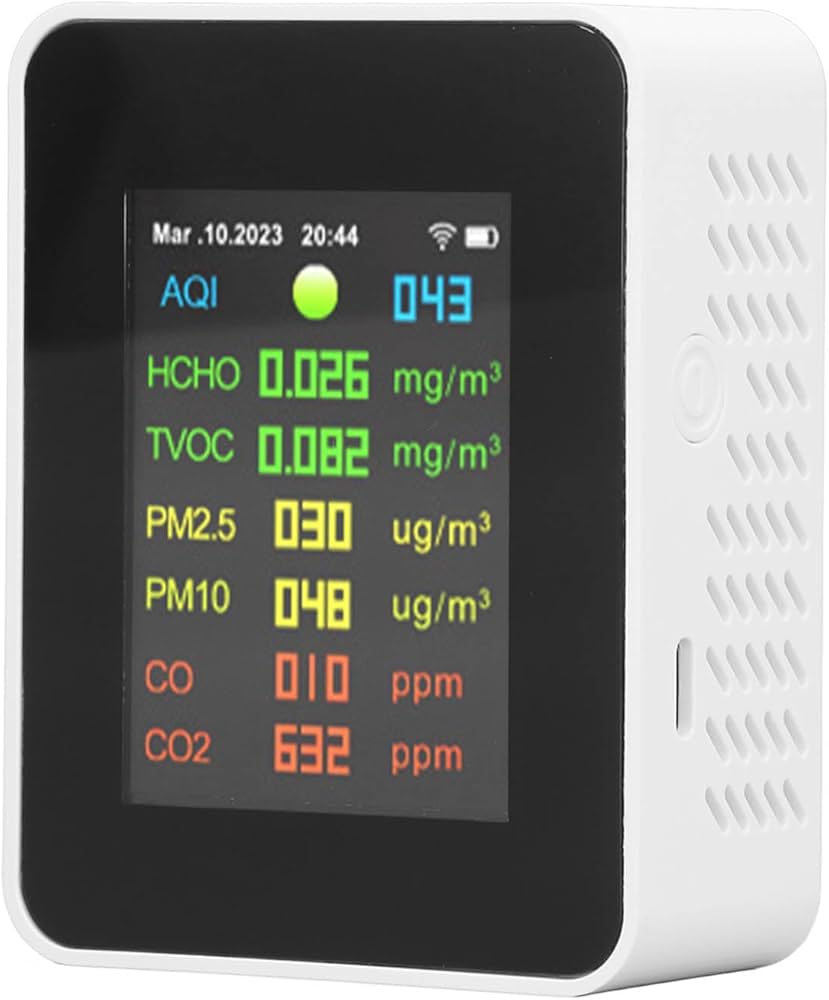
That’s where machine learning comes in. Instead of following a simple rule like “PM2.5 goes up → fan goes up,” machine learning can learn patterns (your routines, your home’s airflow, outdoor conditions) and make a best-guess forecast: “Air quality usually drops around this time, for this reason—so I’ll get ahead of it.”
If you’ve ever noticed your air getting worse right after cooking, during a busy traffic hour, or when wildfire smoke rolls in unexpectedly, this is the exact problem predictive purifiers are trying to solve.
What “Predicting Pollution Spikes” Really Means
Machine-learning air purifiers use sensor data + pattern recognition to forecast short-term air-quality changes (like PM2.5 spikes from cooking, smoke, or outdoor pollution), then automatically increase filtration before levels peak.
Important: this is a probability game, not a crystal ball. The goal isn’t perfect prediction—it’s a faster, smarter response that reduces your exposure window.
Indoor Air Quality (IAQ) isn’t just about buying a device. It’s about reducing pollutants at the source, improving ventilation, and using effective filtration in the right places.
Why Pollution Spikes Happen So Fast Indoors
Indoor air can change rapidly because your home is a closed system with bursts of pollutants. Common spike triggers include:
- Cooking (especially frying, searing, or high-heat oils)
- Wildfire smoke / outdoor PM infiltrating through leaks and door openings
- Cleaning sprays, fragrances, VOC sources (some sensors track VOC trends, not specific chemicals)
- Dust events (vacuuming, bedding, kids/pets, renovations)
- Humidity shifts that affect particle behavior and comfort
Reactive purifiers are helpful—but they often “wake up late.” Predictive systems aim to shorten the lag between the beginning of the spike and full filtration power.
Internal reading suggestion: Understanding Air Purifier Technology: HEPA, Activated Carbon, and Beyond
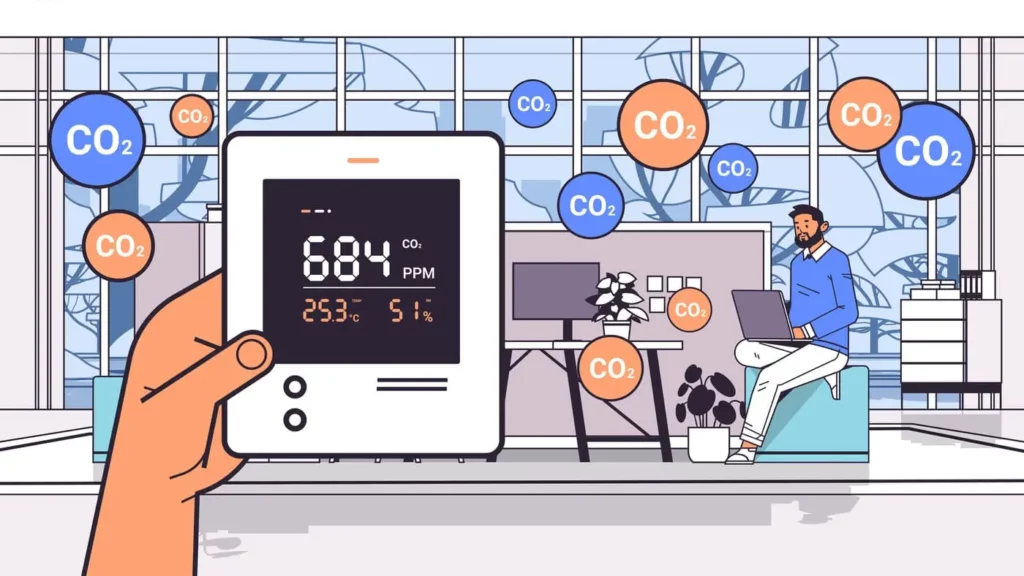
How Machine Learning Works Inside a “Predictive” Air Purifier
Think of machine learning as a pattern-finder with memory. A purifier collects data, learns what “normal” looks like for your home, then estimates what’s likely to happen next based on recurring signals.
Step 1: It measures what’s happening right now
Modern purifiers often use a mix of sensors—most commonly particle sensors for PM (like PM2.5) and sometimes sensors that estimate VOC trends.
Step 2: It learns your home’s baseline patterns
Baselines matter. A home near a busy road behaves differently from a quiet suburban home. A household that cooks twice a day creates different spikes than one that mostly eats out. Machine learning can learn those rhythms and build a “usual day” model.
Step 3: It fuses indoor data with external context (when available)
Some systems may incorporate outside inputs like outdoor AQI trends, temperature/humidity patterns, or even simple time-based behavior (weekday vs weekend patterns). This can help the purifier anticipate smoke events or typical commute-hour pollution waves.
Step 4: It predicts the next few minutes to hours
Instead of waiting for PM to hit a high number, predictive logic may decide: “We’re trending up fast and this looks like a known spike pattern—ramp up now.”
Step 5: It takes action (and checks if it worked)
After it increases fan speed or changes modes, the purifier keeps measuring. If air quality improves quickly, it learns that action worked for that pattern. If it didn’t, it adjusts the next time.
Internal reading suggestion: Smart Air Purifiers Guide: Automation, Sensors & Home Integration
Reactive vs Predictive Purifiers (Quick Comparison)
| What it does | Reactive (Rule-Based) | Predictive (Machine Learning-Inspired) |
|---|---|---|
| Fan control | Responds after pollution rises | Ramps earlier when a spike pattern is likely |
| Comfort | May surge loudly after the spike starts | Smoother ramping can feel less disruptive |
| Effectiveness window | Great for steady issues | Best for sudden spikes (cooking, smoke, events) |
| Personalization | Limited (same thresholds for everyone) | Can adapt to your home’s patterns over time |
| Tradeoffs | Simple, predictable behavior | Depends on sensor quality + model logic + data settings |
Note: brands use different terms (auto mode, smart mode, adaptive cleaning, AI cleaning). The label matters less than the behavior: does it only react, or does it learn and anticipate?
The Sensors That Make Prediction Possible
| Sensor / Metric | What it’s good at | What it can’t prove |
|---|---|---|
| PM2.5 / particle sensor | Tracking smoke, dust, fine particles | Doesn’t identify the source (cooking vs wildfire) |
| VOC / “gas” sensor | Detecting changes in chemical/odor load (trend) | Often can’t specify which VOCs are present |
| Humidity / temperature | Comfort + context for changing conditions | Not a pollution sensor by itself |
| Outdoor AQI integration | Anticipating incoming smoke/pollution trends | Your indoor air may behave differently than outdoor readings |
The best predictive behavior comes from a simple truth: prediction is only as good as measurement. A purifier can’t “learn” spikes it can’t reliably detect.
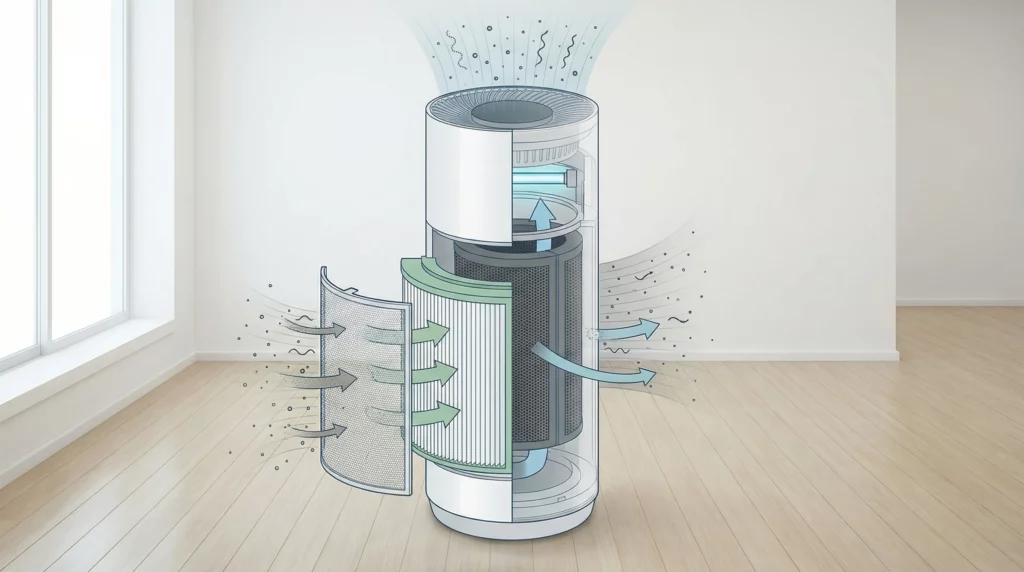
What to Look For If You Want “Predictive” Performance
If your goal is first-page buyer intent alignment, focus on what impacts real outcomes—not buzzwords.
1) Correct sizing (CADR matched to your room)
Prediction doesn’t help if the purifier is undersized. For particle removal, look for a CADR appropriate for the room size. Higher CADR generally means faster cleaning for particles.
2) Real filtration for your problem
HEPA-style filtration is commonly used for particles. For odors and certain gases, activated carbon (or other sorbent media) matters—and the amount of media can affect performance.
3) Smart controls that don’t trap you
Look for the ability to:
- Manually set fan levels (you should always be able to override)
- Schedule modes for predictable routines (sleep, cooking time, allergy hours)
- Use auto mode without constant app babysitting
- Optionally integrate outdoor AQI for smoke events
4) Filter replacement that’s easy and affordable
Predictive features won’t save you if your filter is overdue. The “hidden” buyer-intent win is having a reliable place to grab the right replacement filters on time.
Practical option: Browse replacement filters and purifier essentials at FiltersFast (especially if you want to simplify maintenance across multiple rooms).
5) Whole-home strategy if your HVAC is the main pathway
If your home’s airflow is dominated by HVAC runs, you may get more consistent results by improving whole-house filtration or adding an in-duct IAQ solution—especially for families trying to reduce recurring allergens and comfort issues across multiple rooms.
Whole-home IAQ path: Explore IAQ components and whole-house systems from Field Controls. Many in-duct solutions are best installed or reviewed by an HVAC pro to ensure safe fit and correct airflow.

Do “AI Purifiers” Remove More Pollution Than Standard Purifiers?
Not automatically.
What removes pollution is still the physical work: moving air through the right filter media at the right rate for your space. Machine learning doesn’t replace HEPA, carbon, or proper sizing—it improves timing and behavior.
In plain language: predictive features can reduce the time you spend breathing worse air during spikes, but they’re not magic. They’re an optimization layer on top of solid filtration fundamentals.
FAQs
How does a purifier “know” pollution is coming?
It doesn’t know with certainty. It estimates. It uses your sensor trends (like PM2.5 rising fast), learned routines (like cooking hours), and sometimes outdoor AQI context to decide when a spike is likely.
Is outdoor AQI the same as indoor air quality?
No. Outdoor AQI can hint at what may enter your home (especially during smoke events), but indoor air depends on ventilation, leaks, filtration, activities, and your home’s layout. Outdoor data is a useful context, not a complete indoor measurement.
What’s the most important feature for smoke events?
A strong particle-filtering setup sized correctly for the space (often HEPA-based filtration) plus the ability to run higher airflow when needed. Predictive modes can help react faster, but filtration capacity is the foundation.
Do “gas/VOC sensors” mean the purifier removes VOCs well?
Not necessarily. A sensor can detect changes in air chemistry trends, but VOC removal depends on the type and amount of sorbent media (like activated carbon) and the airflow/contact time.
How often should I replace filters?
It depends on your environment (pets, smoke, allergies, cooking, outdoor pollution). Use the manufacturer’s guidance as a baseline, then adjust based on performance (airflow drop, odor return, rising PM readings, or higher fan noise). Keeping spares on hand helps you avoid “running overdue.”
The Bottom Line
Machine learning in air purifiers is less about flashy tech and more about reducing exposure during real-life spikes. When it’s done well, it learns your home’s baseline, responds earlier, and smooths out air cleaning so you’re not always playing catch-up.
If you want the best outcome, build your buying decision around fundamentals first (sizing + filtration media + maintenance), then treat machine learning as the bonus layer that makes your purifier feel “one step ahead.”
Affiliate Disclosure
This post may contain affiliate links. If you choose to buy through these links, I may earn a commission at no extra cost to you. I only recommend products and resources that match the topic and help readers make practical decisions.
**Reference sources (for factual grounding while writing):** EPA Indoor Air Quality (IAQ) overview and guidance on air cleaners/filters ([US EPA][1]); AirNow AQI basics and current air-quality data context ([AirNow][2]); research literature on machine-learning approaches used in air-quality/PM2.5 prediction and spike capture (including wildfire contexts) ([ScienceDirect][3]); ozone-emission certification context for air-cleaning devices in California ([California Air Resources Board][4]); Field Controls whole-house IAQ product pages used only for accurate brand-specific descriptions ([fieldcontrols.com][5]).
[1]: https://www.epa.gov/indoor-air-quality-iaq?utm_source=chatgpt.com “Indoor Air Quality (IAQ)”
[2]: https://www.airnow.gov/aqi/aqi-basics?utm_source=chatgpt.com “Air Quality Index (AQI) Basics”
[3]: https://www.sciencedirect.com/science/article/abs/pii/S0048969722075489?utm_source=chatgpt.com “Predicting hourly PM2.5 concentrations in wildfire-prone …”
[4]: https://ww2.arb.ca.gov/list-carb-certified-air-cleaning-devices?utm_source=chatgpt.com “List of CARB-Certified Air Cleaning Devices”
[5]: https://www.fieldcontrols.com/duo-2000-uv-whole-house-air-purification-system/?utm_source=chatgpt.com “Duo 2000 Whole House Air Purification System”