Learn what your purifier’s sensors detect (PM2.5, VOCs, humidity), what they miss (CO, radon), and how to choose the right purifier and filters for cleaner air.

Your home can look spotless and still be full of “invisible mess.” Not the kind you wipe off a countertop—the kind you breathe. The twist is that modern smart air purifiers can detect a chunk of that mess in real time, even when your eyes and nose swear everything is fine.
If you’ve ever watched an air-quality number spike after cooking, vacuuming, spraying a cleaner, lighting a candle, or just opening a window on a high-pollen day, you’ve already seen the story: there’s a whole layer of indoor pollution happening under the surface.
This guide breaks down what your smart purifier can actually “see,” what it can’t, and how to make buying decisions that match real-world indoor air problems—without hype, fear tactics, or pretending every sensor is a medical-grade lab instrument.
What “Hidden Pollutants” Can a Smart Purifier Detect?
Most smart air purifiers detect airborne particle levels (often PM2.5) using optical sensors. Some models also estimate VOC levels (chemical fumes) with gas sensors and track humidity and temperature. These sensors help identify pollution events such as cooking smoke, pet dander bursts, dust resuspension, and fragrance or cleaner fumes—but they may not accurately detect carbon monoxide, radon, or other gases.
Bottom line: Smart sensors are best used as trend indicators and automation triggers—not as definitive medical diagnostics.
What Your Smart Purifier Is Really Measuring (In Plain English)
When a purifier “sees” pollution, it’s not using a magic detector that identifies every contaminant by name. It’s usually using one (or more) of these sensor types:
1) Particle sensors (often labeled PM2.5)
These are typically optical sensors that shine a light through the air and count how much light scatters off tiny particles. More particles = more scattering = higher reading.
What it’s good at: detecting smoke, dust, pollen bursts, lint, and general “stuff in the air.”
What it’s not: it doesn’t tell you what the particles are—only that there are more of them right now.
2) VOC sensors (chemical “fume” indicators)
Some smart purifiers include a gas sensor (often a metal-oxide sensor) that reacts to a range of volatile organic compounds. Think: fragrances, solvents, some cleaning chemicals, off-gassing from paints or new furniture, and cooking-related fumes.
Important reality check: Many VOC sensors provide an estimated or “relative” reading rather than a precise lab measurement. They can be useful for seeing patterns (like “my VOCs jump when I use this cleaner”) but aren’t always specific or perfectly accurate.
3) Humidity and temperature sensors
These don’t measure pollutants directly, but they matter because humidity affects how air feels, how particles behave, and the likelihood of mold growth. Smart purifiers sometimes use humidity data to adjust fan behavior or help you spot problem areas in the home.
4) CO2 sensors (less common in purifiers)
CO2 tracking is more common in dedicated indoor air quality monitors than in most air purifiers. CO2 is mainly a ventilation indicator (it rises when people are breathing in an enclosed space). A purifier can’t remove CO2, but CO2 data can tell you when fresh air is needed.
If you see a purifier advertising CO2 removal, treat that claim carefully. Ventilation is usually the real solution for CO2.
Comparison Table: What Smart Purifiers Detect vs. What They Often Miss
| “Hidden” air issue | Can many smart purifiers detect it? | Typical sensor type | What it looks like in real life | What actually helps |
|---|---|---|---|---|
| Cooking smoke / burnt food | Often yes | PM2.5 particle sensor | Air quality spikes fast, then declines after cleanup | Purifier on high + vent hood + window/ventilation |
| Dust resuspension (walking, vacuuming) | Often yes | PM2.5 particle sensor | Short spikes during activity | HEPA filtration + better vacuuming + filter changes |
| Pollen bursts (open windows, clothes, pets) | Often yes (as particles) | PM2.5 / particle sensor | Seasonal spikes; can surge after doors/windows open | HEPA filtration + entryway habits + HVAC filtration |
| Pet dander (airborne periods) | Sometimes | Particle sensor | Spikes during brushing or play | HEPA filtration + grooming + cleaning routines |
| VOC fumes (cleaners, fragrances, paint) | Sometimes | VOC/gas sensor | VOC reading rises after sprays or new items | Ventilation + carbon/adsorbent media (when present) + source control |
| Humidity-related mold risk | Sometimes (humidity only) | Humidity sensor | Humidity stays high in bathrooms/basements | Dehumidification + moisture control; purifier helps with spores already airborne |
| Carbon monoxide (CO) | Usually no | Requires a CO alarm/sensor | No smell; dangerous | Use certified CO alarms; fix combustion sources |
| Radon | Usually no | Requires radon test/sensor | Basements/ground-level risk; invisible | Radon testing + mitigation system |
| Gas stove NO2 (nitrogen dioxide) | Usually no | Specialized sensors | Irritation risk in poorly ventilated kitchens | Vent hood + ventilation + consider induction; purifier helps with particles but not always gases |
Key takeaway: “Smart” typically means particle-aware automation. Gas tracking varies widely by brand and model, and some hazards (CO, radon) require dedicated detectors.
The Pollutants You Notice vs. The Ones You Don’t
Most people assume indoor air problems announce themselves: a bad smell, visible dust, a smoky haze, a musty basement. Sometimes that’s true. But many common pollution events are quiet—and that’s where smart purifier sensors earn their keep.
Invisible particle surges happen more often than you think
A quick example: you can create a measurable particle spike by simply making toast, searing food, or running a blender that throws fine flour into the air. You might not see smoke, but your sensor does.
Another underappreciated trigger is “cleaning that looks clean.” Dry dusting, sweeping, or shaking fabrics can lift settled particles back into breathing height. A smart purifier sees that as a sudden rise and can automatically ramp up airflow.
Chemical fumes can be “clean smelling” and still be irritating
Fragrance doesn’t equal freshness. Some homes have recurring VOC peaks due to air fresheners, scented candles, harsh cleaners, or off-gassing from new products. If your purifier has a VOC indicator, it may reveal a pattern you can’t sense until it becomes a headache or a persistent “why does the air feel heavy?” feeling.
That said, VOC sensors are best used as a guide to habits: identify triggers, reduce sources, and ventilate. A purifier’s carbon layer (if it has one) can help with some odors and some VOCs, but “chemical control” is usually a mix of source control + ventilation + filtration.
Humidity is the slow-burn pollutant multiplier
Humidity isn’t a pollutant, but it’s a powerful amplifier. High humidity can increase discomfort complaints, worsen musty conditions, and increase the risk of mold growth in problem areas. A smart purifier that tracks humidity can be your early warning sign that a bathroom fan is underperforming, a basement needs dehumidification, or a leak is quietly creating a future headache.
Why Smart Sensors Sometimes “Seem Wrong” (And What to Do About It)
If you’ve ever thought, “My purifier says the air is bad, but nothing is happening,” you’re not alone. Here are the most common reasons smart sensors confuse people:
1) Placement makes or breaks the readings
Put a purifier too close to a kitchen, humidifier, diffuser, or open window, and you may get constant spikes. Put it in a dead-air corner, and it may underreport what the room is actually experiencing.
Practical fix: place the purifier where it can sample general room air—not directly in a pollution stream and not jammed behind furniture.
2) VOC sensors react to “categories,” not exact chemicals
Many VOC sensors are sensitive to a wide range of compounds and can also drift. The reading is still useful for noticing changes (before/after you use a product), but treat the number as a signal, not a diagnosis.
3) “Auto mode” is only as good as your goals
Auto mode often prioritizes noise control and energy savings. That’s great for normal days. But during allergy season, wildfire smoke events, construction, or deep cleaning, you may want to override auto mode and run a higher fan speed for a set period.
Smart strategy: use auto mode for baseline control, and create a simple routine: “High for 30–60 minutes during cooking,” “High for 2 hours after vacuuming,” “High overnight during peak allergy weeks,” etc.
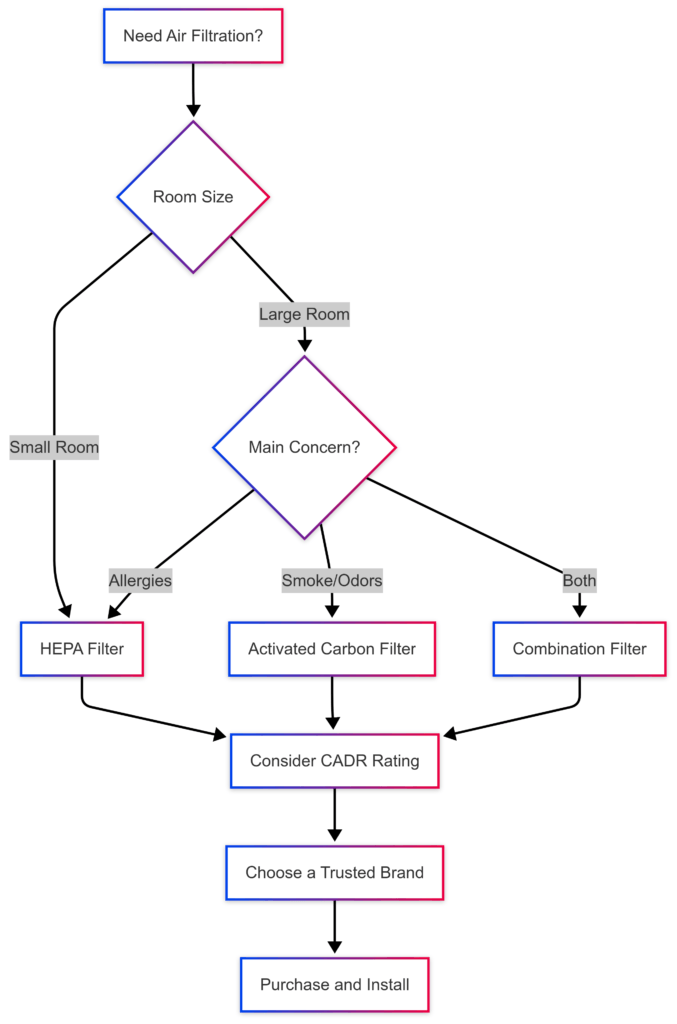
The Filter Matters More Than the App
Apps are convenient. Sensors are helpful. But if your goal is cleaner air, the filter setup and replacement schedule are still the main event.
Here’s a simple way to think about it: a smart purifier can tell you when something is happening. But the filter performance determines how much it can actually improve the air once the fan ramps up.
The three filter layers you’ll see most often
1) Pre-filter: catches large lint, hair, and dust. Keeping this clean helps the purifier maintain airflow and protects the main filter.
2) HEPA (or HEPA-like) filter: captures fine particles like dust, pollen, and smoke particles. This is usually the core of particle removal.
3) Carbon/adsorbent layer: helps with odors and some gases/VOCs, depending on thickness and material. Not all carbon filters are equal—some are thin “odor pads,” others contain more substantial media.
Where people lose results: running a great purifier with a filter that’s exhausted. Smart sensors may still show spikes, but the purifier can’t “catch up” because airflow is restricted or the filter media is spent.
FiltersFast: The easiest performance upgrade is staying on schedule
If you’re serious about indoor air quality, consistent filter replacement is one of the highest-ROI habits you can build. If you want a straightforward way to shop for and restock filters, check out FiltersFast (affiliate link).
Note: If you buy through that link, I may earn a commission at no extra cost to you. I recommend it because replacing filters on time keeps purification performance from quietly slipping backwards.
Smart Purifier vs. Whole-Home IAQ: When Room Purifiers Aren’t Enough
Room purifiers are excellent for bedrooms, offices, nurseries, and living areas—but some indoor air problems are better addressed at the HVAC or ventilation level.
If you’re dealing with:
- recurring dust across the whole house,
- ventilation issues (stuffy rooms, high CO2 readings on monitors),
- humidity problems in basements,
- or filtration needs across multiple floors,
…it may be worth looking at whole-home air quality solutions and filtration accessories alongside room purifiers.
Field Controls: For homeowners thinking beyond one room
If you want to explore HVAC-connected indoor air quality products, you can browse Field Controls here: Field Controls or use this link if you prefer: FieldControls (affiliate link).
Ethical note: If you purchase through the affiliate link, I may earn a commission at no extra cost to you. I’m including it because many “mystery air” problems aren’t just a room issue—they’re airflow, filtration, and ventilation issues across the home.
How to Choose a Smart Purifier Based on the Pollutant You’re Fighting
This is where most buying guides get it wrong: they rank purifiers like phones. But air cleaning is contextual. The “best” purifier depends on your dominant pollutant type and where it’s happening.
If your main problem is dust, pollen, pets, or smoke particles
Prioritize strong particle filtration and enough airflow for the room size. Smart particle sensing (PM2.5) and a reliable auto mode are useful, but airflow + filter quality remain the foundation.
If your main problem is odors or chemical sensitivity
Look for meaningful carbon/adsorbent media—not just a thin “odor pad.” A VOC indicator can help you spot triggers, but don’t rely on VOC numbers alone. Source control and ventilation still matter.
If your main problem is humidity and mustiness
A purifier can reduce airborne particles (including some spores and dust), but it won’t remove moisture. Pair filtration with dehumidification and better ventilation in the problem zone.
If your concern is gas hazards like CO or radon
Use dedicated detectors and testing. A purifier is not a substitute for safety devices or mitigation systems.
Quick Decision Table: Which “Hidden Pollutant” Is Most Likely in Your Home?
| If you notice… | Most likely issue | What to check first | Best next step |
|---|---|---|---|
| Allergy symptoms indoors, especially mornings | Pollen/dust in bedroom air | Bedroom purifier placement + filter age | Run purifier higher overnight; replace filters on schedule |
| Air feels “heavy” after cleaning or fragrance use | VOCs/fragrance sensitivity | Which products trigger it | Reduce sources + ventilate; consider carbon media |
| Spikes on the purifier during cooking | Fine particles from cooking | Vent hood performance | Use hood + purifier boost routine during/after cooking |
| Musty basement or bathroom | Humidity-driven issues | Humidity % and ventilation | Dehumidifier + improve exhaust; purifier helps airborne particles |
| Stuffy rooms with multiple people | Ventilation/CO2 buildup | Outdoor air exchange | Ventilation improvements; purifier supports particles but not CO2 |
FAQ
Can a smart air purifier detect mold?
Most purifiers don’t “detect mold” directly. They may detect particles that rise when mold spores or dust increase, and some track humidity (a mold risk factor). If you suspect mold, focus on moisture control and investigate the source.
Do purifier VOC sensors measure formaldehyde accurately?
It depends on the sensor type and model. Many purifier VOC sensors provide a broad VOC estimate or trend indicator rather than a precise chemical-specific reading. They’re useful for noticing changes when something off-gasses, but not all are formaldehyde-specific.
If my purifier shows PM2.5 levels are high, what should I do?
First, identify the trigger (cooking, candles, vacuuming, open windows, outdoor smoke). Then run the purifier at a higher speed for a set period and reduce the source if possible. If spikes are frequent, check filter age and placement.
Is “Auto mode” enough for allergies?
Auto mode is a good baseline, but many people do better with a schedule: higher airflow in bedrooms at night during peak allergy seasons, plus filter changes on time.
Do air purifiers remove viruses or bacteria?
Some filtration systems can capture airborne particles, including biological material, but effectiveness depends on filtration performance, airflow, and conditions. A purifier is a support tool, not a replacement for ventilation, hygiene, or medical guidance.
Practical “Make It Work” Tips (The Stuff That Changes Results)
- Run it where you breathe: Bedrooms and home offices tend to give the biggest quality-of-life improvements.
- Don’t hide it: Air needs to circulate through the intake and outflow. A purifier jammed in a corner performs like a muffled speaker.
- Use boosts strategically: Cooking, cleaning, and high-pollen entry events benefit from timed high-speed runs.
- Track patterns, not perfection: Your goal isn’t “perfect numbers,” it’s fewer spikes and faster recovery.
- Replace filters before performance collapses: Waiting too long often results in louder operation and weaker cleaning.
Let Your Purifier Show You the Invisible, Then Take Control
The best part of a smart purifier isn’t the app. It’s the moment you realize your home has air-quality “events” you never noticed—until you watched them happen in real time.
Use that data the right way: find your triggers, tighten your routines, keep filters fresh, and upgrade your whole-home strategy if the problem is bigger than one room. When you do, smart purification becomes less like a gadget and more like a quiet system that keeps your baseline cleaner—day after day.
Helpful next steps
• Need replacement filters or want to stay consistent? Browse FiltersFast here (affiliate link).
• Looking into whole-home IAQ options? Explore FieldControls here (affiliate link) or visit FieldControls.com.
Disclosure