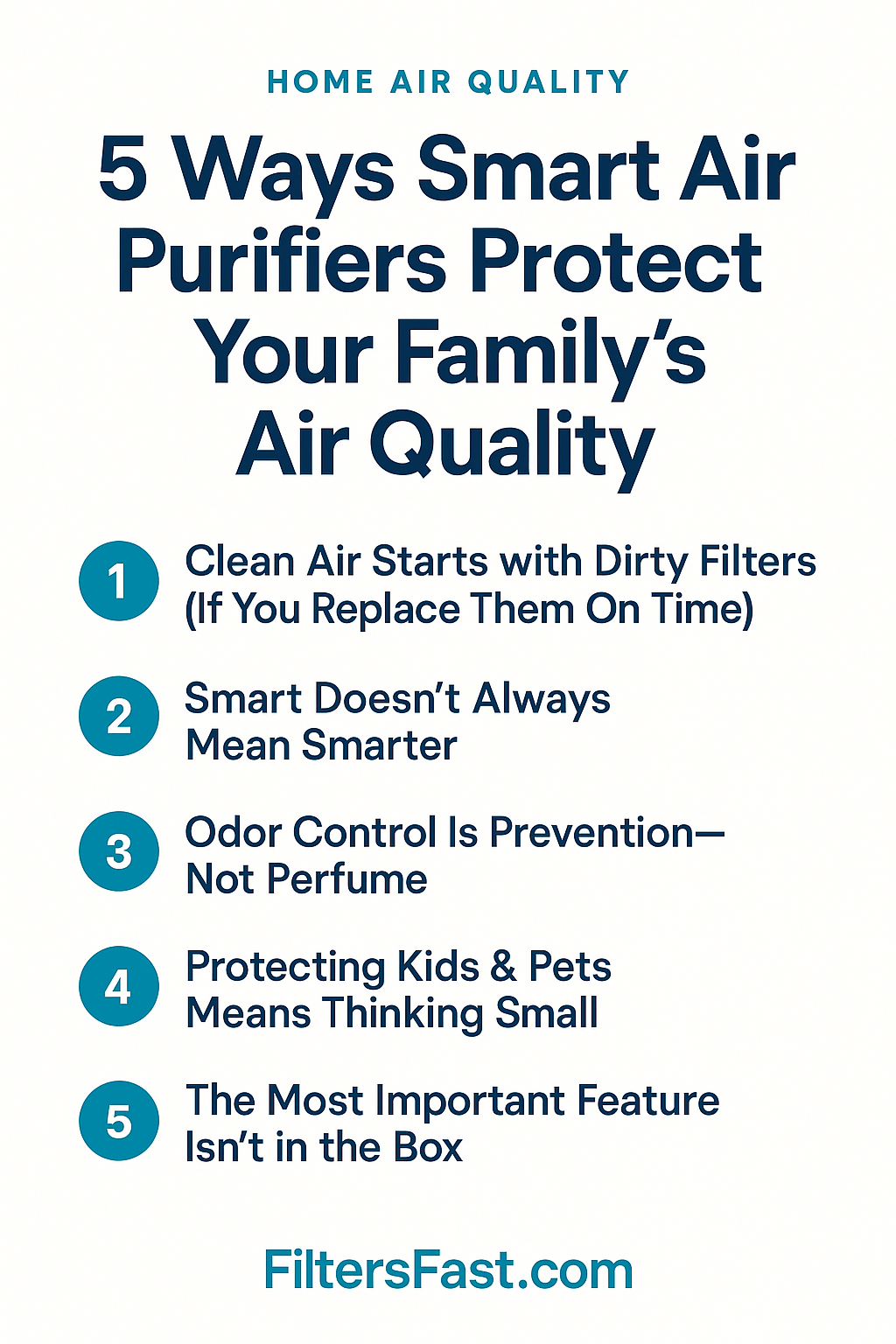
Smart air purifiers improve air quality by using real-time sensors to automate fan speeds. When PM2.5 or VOC levels rise, the device immediately increases filtration intensity, capturing pollutants faster than manual units.

Modern “smart” air purifiers promise a “set it and forget it” solution to indoor pollution. By using onboard Laser Particle Counters (LPCs) and TVOC (Total Volatile Organic Compound) sensors, these devices claim to monitor and mitigate threats in real time.
However, the efficacy of a smart purifier depends less on its Wi-Fi connectivity and more on the calibration of its internal sensors and its Clean Air Delivery Rate (CADR). This report analyzes whether smart sensors provide clinical accuracy or merely marketing appeal, supported by data on filtration standards.
The Reality of Smart Sensor Accuracy
Most consumer-grade smart purifiers use infrared or laser-based PM2.5 sensors. While these are effective at detecting significant spikes—such as smoke from cooking or sudden dust disturbances—they often lack the precision of laboratory-grade monitors (like a TSI SidePak).
How Smart Sensors React to Pollutants
- PM2.5 (Fine Particulate Matter): Most smart units excel here. They detect particles down to 2.5 microns and automatically ramp up fan speeds.
- VOCs (Chemical Vapors): Accuracy varies wildly. Many budget-smart purifiers lack dedicated VOC sensors, relying solely on particle counts that do not detect gases, odors, or formaldehyde.
- Auto-Mode Lag: There is often a 30-60 second delay between a pollution event and the sensor triggering a higher fan speed.
Comparison of Air Purification Technologies
| Feature | Standard HEPA Purifier | Smart HEPA Purifier | Commercial/Whole-Home Systems |
|---|---|---|---|
| Detection | Manual observation | Onboard PM2.5/VOC sensors | High-precision pressure switches |
| Response | Constant speed (Manual) | Variable speed (Automated) | Integration with HVAC/BMS |
| Data Tracking | None | Mobile App/Historical Logs | Real-time professional monitoring |
| Filter Life | Timer-based (Estimated) | Usage-based (Sensor tracked) | Pressure-drop monitored |
| Best For | Budget-conscious users | Tech-focused households | Allergy clinics & large estates |
Does Automation Improve Air Quality?
The primary advantage of a smart purifier is the Auto-Mode. In a traditional unit, users often leave the device on “Low” to minimize noise, which may be insufficient during high-pollution events. A smart purifier identifies the spike and forces the motor into “High” or “Turbo” mode, cleaning the air volume faster than a human could manually intervene.
However, for maximum efficacy, the hardware must match the software. A smart sensor is useless if the filter media is substandard. To maintain the integrity of your air quality data and machine performance, using certified replacement filters is mandatory.
For high-performance replacement media that meets OEM specifications, consumers should utilize verified distributors:
- Find specialized replacement filters at FiltersFast.
- Browse comprehensive inventories at FiltersCollection.
- For professional-grade air treatment solutions, visit FieldControls.
Frequently Asked Questions,
Are smart air purifier sensors accurate?
Smart air purifier sensors are generally accurate for detecting trends and significant spikes in PM2.5 (dust and smoke). However, they are not a substitute for medical-grade air monitors, as they can sometimes misinterpret high humidity (steam) as high pollution.
Do smart purifiers save electricity?
Yes. By using Auto-Mode, the purifier only runs at high wattage when pollutants are detected. Once the air is cleared, the device drops to a low-energy “Silent” or “Eco” mode, reducing overall consumption compared to a unit left on medium-high constantly.
Is a smart air purifier worth the extra cost?
It is worth the investment if you live in an area prone to wildfires, have severe allergies, or forget to adjust settings manually. The “Smart” aspect ensures the device responds to invisible threats, such as VOCs or nighttime pollen spikes, while you sleep.
Technical Maintenance and Filter Integrity
The “Smart” functionality of these devices often includes a filter life monitor. Unlike traditional timers, these sensors calculate the volume of air processed. When your app indicates a filter change is necessary, using a high-efficiency replacement ensures the CADR remains at peak levels.
Failure to replace filters when prompted increases motor pressure and reduces particle capture, rendering the “Smart” sensors ineffective, as they will continuously report poor air quality despite the machine running.